





Additional features
-
Night mode

Public opinion: Number of people who paid in advance to buy a car has approached 90,000. Do citizens need a monopolistic UzAuto Motors?
UzAuto Motors has been sharply criticized for the poor quality, high cost and occasional unreasonable increase in car prices. Perhaps it is high time to take advantage of the alternatives?
Endless queues
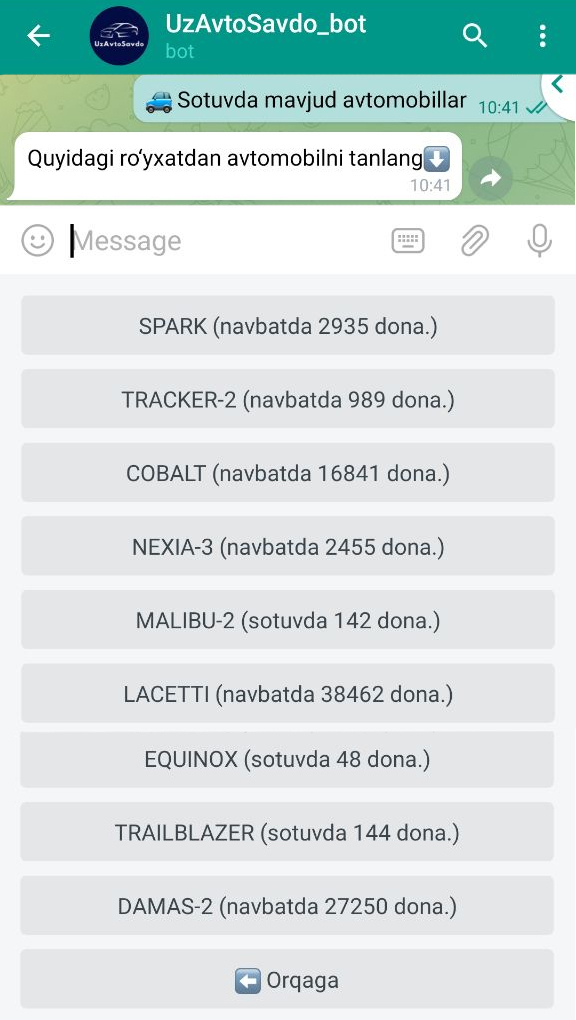
According to UzAvtoSavdo_bot data, 88,932 people have paid in advance and are currently waiting for the delivery of their cars. As of November 15, 2021:
- 38,462 people have made certain payments for Lacetti and are waiting for their turn to come;
- 27,250 – for Damas;
- 16,841 – for Cobalt;
- 2935 – for Spark;
- 2455 – for Nexia-3;
- 989 – for Tracker.
There are only such cars on sale as Malibu-2, Trailblazer, Equinox, the price of which is not affordable for most Uzbeks. While the company has promised to reduce queues, they continue to grow gradually.
The more supply there is in a market with healthy competition, the more it will serve the interests of the manufacturer. But today, consumers have no other choice. This is why people are forced to accept the company’s overly molded offers.
Production capacity
According to the State Statistics Committee, the volume of passenger car production in Uzbekistan decreased by 31% compared to a year earlier: in January-September 2021, 150,183 cars were produced.
For comparison, the number of cars produced in 9 months was 217,771 in 2020 (during the same pandemic period), and in 2019 – 186,432.
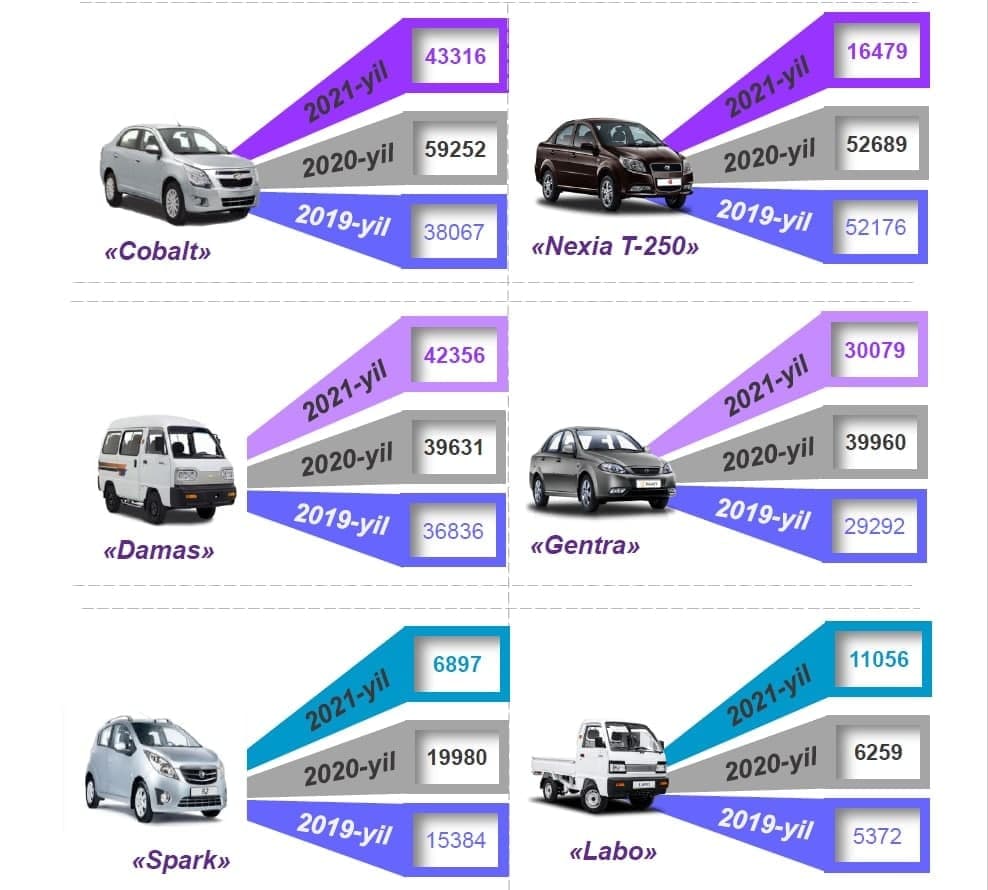
Production of some high-demand car models has fallen sharply. In the first 9 months, Spark production fell by almost 3 times, Nexia-3 production – by 3.2 times, Cobalt production – by 27%, and Lacetti production – by 24.8%.
The company is not tired of repeating that the sharp decline in the automotive industry is caused by a shortage of microchips observed around the world. It is true that there is a real shortage of microchips in the world. But in countries with a free market environment, this does not create inconvenience for buyers because they have a choice.
At a time when the number of Uzbeks who have paid in advance to buy a car is growing, it makes no sense to understand UzAuto Motors’ agreement to open a plant in Tajikistan and Turkmenistan.
For information: In the first six months of 2021, UzAuto Motors received 1.9 trillion soums ($177.6 million) in customs benefits and preferences. The bulk of these 1.9 trillion soums of benefits fall on customs duties – 1.64 trillion soums, as well as VAT – 255.6 billion soums, excise tax – 356.7 million soums. During the same period, UzAuto Motors earned a net profit of 902 billion soums. Comparing the benefits and preferences given to the company’s profit, the loss is 1 trillion soums.
Swindling monopolist
A few months ago, the company introduced an updated Chevrolet Captiva, and delivery of the car was scheduled to begin in 2022. As a result, many people have signed a contract for this very car. But recently, it has been reported that the new Captiva will not be delivered to buyers on the pretext that the new car “doesn’t fit in our region”. Spontaneous questions naturally arise: before a new car was introduced to the market and a contract was signed, was it not studied whether it would fit into the region? What aspects are not relevant to the region?
The company has not yet commented on the above situation.
Earlier, UzAuto Motors said that it would not be able to fulfill its Lacetti and Labo supply contracts in October-November, it would sell Cobalt cars without a seat heating module.
The largest protests against the Uzavtosanoat monopoly took place in 2020. Initially, deputies of the Legislative Chamber of Oliy Majlis expressed their objections at a meeting with representatives of the company’s management.
Later, the Federation of Consumer Rights strongly condemned the increase in car prices and accused UzAuto Motors of monopoly. The Antimonopoly Committee also reacted sharply to the increase in the price of UzAuto Motors cars, noting that consumer rights are being violated.
Do we need UzAuto Motors?
For several years, the company has been sharply criticized for the poor quality, high cost of cars produced in Uzbekistan, and the unjustified increase in car prices from time to time.
Economist Mirkomil Kholboyev stressed that the best and most appropriate solution to the problems with UzAuto Motors should be foreign trade. That is, such cases occur in the domestic market due to problems in foreign trade.
“Let’s think about the consequences of the partial opening of the borders. Imagine if the government removes all other barriers to car imports and imposes a 10% duty on imported cars and customers pay 15% value-added tax for imported cars, then the total barriers at the border amount to 25% (about 3-4 times lower than the current state). What will be the consequences if our national plant completely loses the domestic market to foreign manufacturers (that is, ceases to operate) and the annual consumption of passenger cars reaches 350,000, after a sharp reduction in barriers?
If the average cost of an imported car is about $10,000, then the total revenue from the 10% tariffs under the new regime will be $350 million, or about 3.7 trillion soums. The total revenue from 15% VAT is $525 million or about 5.6 trillion soums.
According to the State Tax Committee, the total amount of taxes paid by the plant in 2020 amounted to 2 trillion soums. If we pay attention, the VAT revenues are 2.8 times more than the taxes paid by the plant. That is, if the government makes the above decision, tax revenues to the budget will not decrease, but may increase by an additional 3.6 trillion soums (and this amount will be even higher with duties). I think that the 10% customs revenue is also much higher than the revenue from imported cars now (because some stakeholders, especially UzAuto Motors, are importing cars duty-free in exchange for various benefits).
In other words, the reduction of border duties to the level I propose will not result in any loss to the state budget, but may significantly increase budget revenues (even if we take into account the loss of tax revenues from plants producing other spare parts related to the company, there is likely to be an increase in budget revenues).
The conclusion is that partial maintenance of the level of border duties for car imports (total barriers are around 20-25%) will not only bring great benefits to consumers, but also a significant increase in state budget revenues from such a decision. Naturally, overall well-being will also increase. It is enough to have a strong will to make such a decision,” the economist said.
Import-based automotive industry
It has been 25 years since the beginning of car production in Uzbekistan (since 1996). During this period, the company has been provided with many benefits, concessions have been made and this is still going on in various forms.
The analysis of the structure of Uzbekistan’s imports over the past 20 years shows that the share of machinery in the structure of imports remains stable at 40%. Nevertheless, the share of machinery and equipment in exports does not exceed 2-3%.
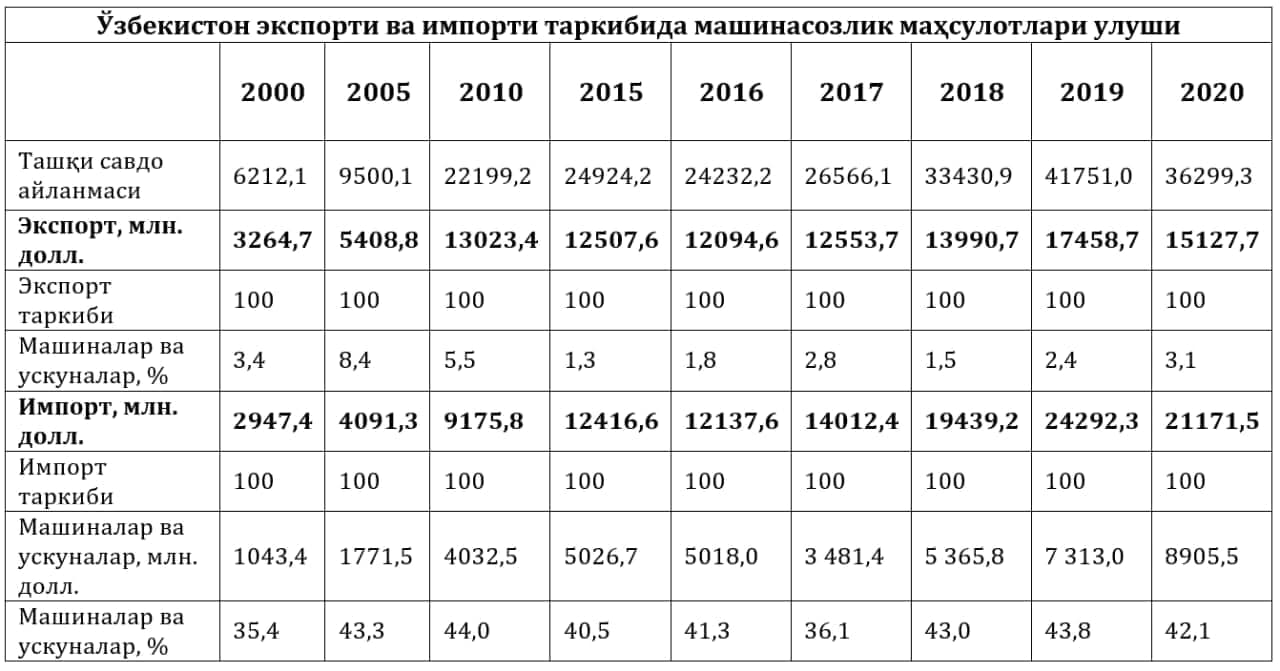
Imports of machine-building products are on the rise, which is growing from year to year. Such a situation does not lead to technical and technological re-equipment of the economy. As a result, even though the product is produced in-house, it becomes more expensive due to the net cost.
In conclusion, perhaps it is high time to take advantage of other better opportunities in a situation where our domestic producer cannot meet consumer demand…
Related News
16:44 / 05.05.2025
Uztransgaz and Uzenergosotish lose market monopolies amid WTO reforms

12:21 / 20.03.2025
Five companies dominate Uzbekistan’s import market for personal care products

19:02 / 05.03.2025
Competition Committee to disclose the list of entities with exclusive rights
17:09 / 24.02.2025